
First aid training
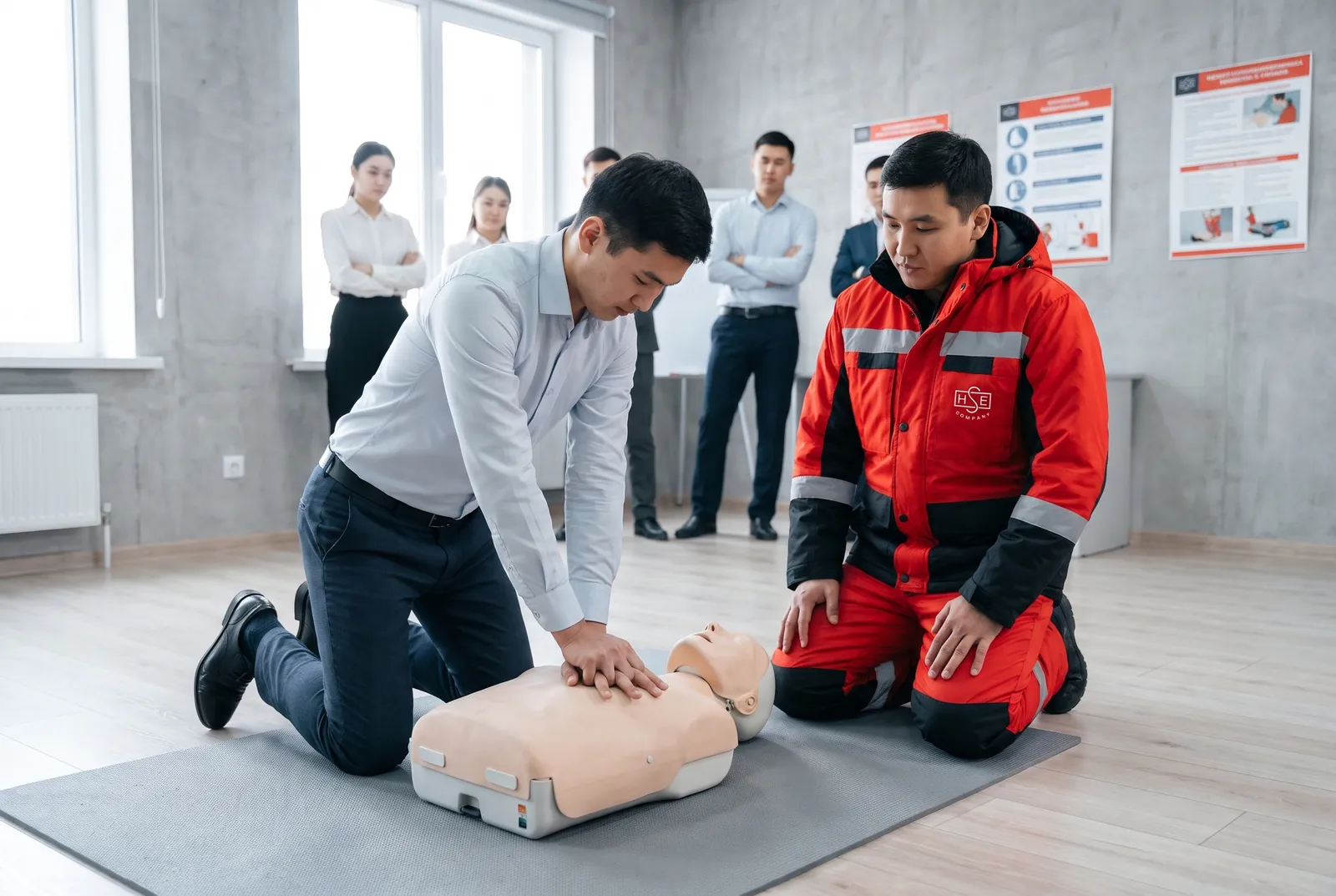
We teach what to do in the first minutes after an accident: stop bleeding, perform CPR and call an ambulance correctly. More practice than lectures.
Free consultation and quote
Among our clients

















About the course
Until the ambulance arrives, it's down to the people nearby
At industrial and construction sites an ambulance doesn't arrive straight away, especially at remote locations. The course teaches how to assess the casualty, call emergency services and help until they arrive. Every participant practises resuscitation and bandaging themselves.
- Assessing the casualty
- Consciousness, breathing, circulation — following a clear algorithm.
- Emergencies
- Bleeding, fractures, burns, loss of consciousness.
- Resuscitation
- Cardiopulmonary resuscitation practised on a mannequin.
Who and what
Who the course is for and what it gives
Who it's for
- Employees of companies and organisations
- Managers and engineers
- Occupational safety specialists
- Those responsible for first aid
- Staff at industrial and construction sites
Result
- Practical first aid skills
- Practised CPR
- Algorithms for injuries and accidents
- Confidence in an emergency
- Officially recognised certificate
Programme
What we practise on the course
Just enough theory to understand what you are doing. The rest is practice on a manikin and with each other.
- 01Safety and calling for helpAssessing the scene, calling an ambulance on 103 or 112: what to tell the dispatcher.
- 02Assessing the casualtyConsciousness, breathing, signs of a life threat — step by step.
- 03Cardiopulmonary resuscitationCompressions and rescue breaths on a manikin, using an automated defibrillator.
- 04Recovery positionHow to position a person who is unconscious but breathing.
- 05ChokingTechniques for an adult who is choking.
- 06BleedingDirect pressure, pressure bandage, tourniquet.
- 07InjuriesFractures, dislocations, head and spine injuries, falls from height.
- 08Burns and frostbiteThermal, chemical and electrical burns; help with hypothermia.
- 09Electric shock and poisoningReleasing a person from current, gas and chemical poisoning.
- 10First aid kit at workWhat it should contain and how to use it.
Why it matters
Why the course is needed even where there is a medical post
The first minutes
When the heart stops, a person's chances drop quickly with every minute without CPR.
Remote sites
Ambulances take a long time to reach oil fields and rotation camps: colleagues have to help.
Confidence
Someone who has practised the steps by hand does not freeze in a real emergency.
Client requirements
Major clients require first-aid-trained people on every shift.
Documents
What you receive
We issue documents for every employee and closing documents for your accounts department.
Certificate
Standard form, for each participant.
List of trained employees
For reporting to clients and inspectors.
Closing documents
Contract, invoice, certificate of completion.
Format
Where and how training takes place
Training centre in Astana
Classroom at: Business Centre Centro, 5 Kayym Mukhamedkhanov St, Astana. Equipment and PPE for practice on site.
On-site at your facility
We travel with an instructor and an exam board to any region of Kazakhstan. We also train in Uzbekistan.
A group of your own employees
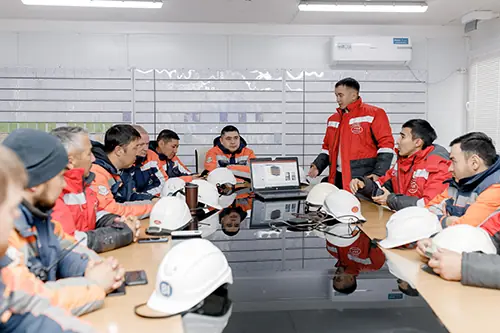
We form a group for your company and fit the schedule around shifts and rotations.
Payment from subsoil users' 1% obligation
The training centre is accredited by CAAAE, so training of Kazakhstani personnel can be carried out under a subsoil user's obligations.
Kazakhstan. We work in Astana and travel to the regions: Almaty, Atyrau, Aktau, Shymkent, Karaganda, Taraz, Ust-Kamenogorsk, Semey, Petropavlovsk.
How we work
From request to certificate
Request
Message us on WhatsApp or call: which course, how many people and where it's convenient to study.
Quote
We confirm the programme, price and nearest dates.
Contract
We sign a contract with your company, issue an invoice and prepare closing documents.
Classes
At our training centre in Astana or at your site.
Documents
Knowledge assessment, record and a document for each employee.
Photos
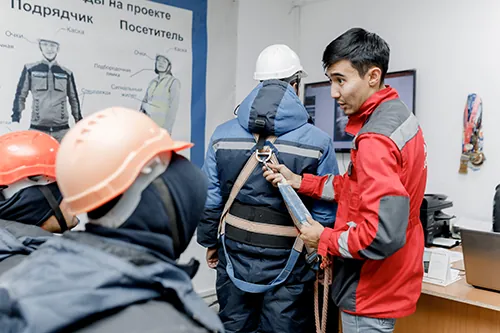
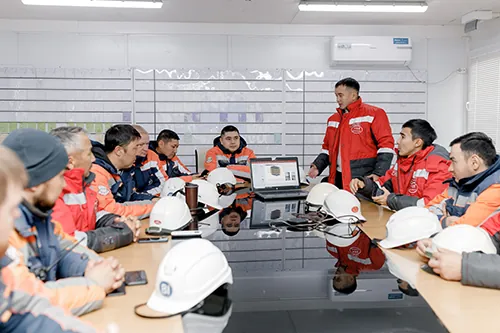
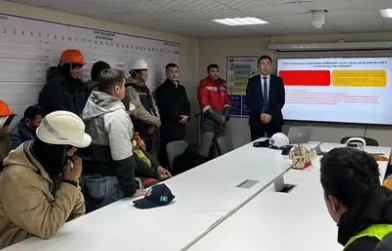
What our training looks like
About us
HSE Company — safety you can trust
We train managers, specialists and workers, carry out audits at hazardous facilities, inspect lifting equipment and provide construction supervision.
Documents
We work under licences and attestations
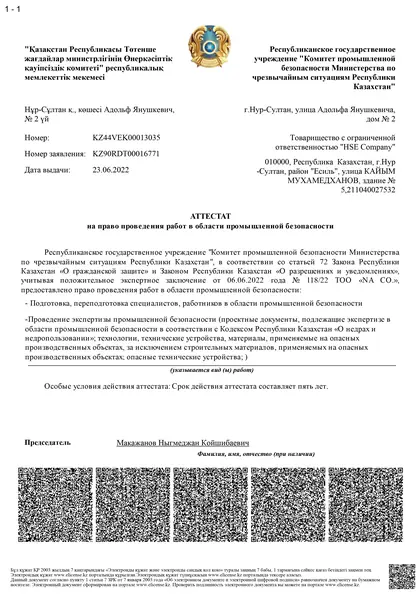
Industrial safety attestation
Industrial Safety Committee of the Ministry of Emergency Situations of Kazakhstan: training of specialists and workers, industrial safety reviews.
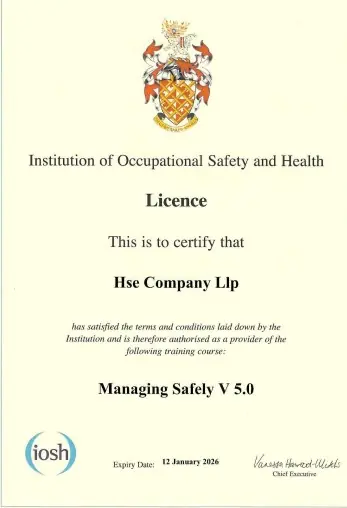
IOSH licence
The right to run IOSH Managing Safely and issue international certificates.
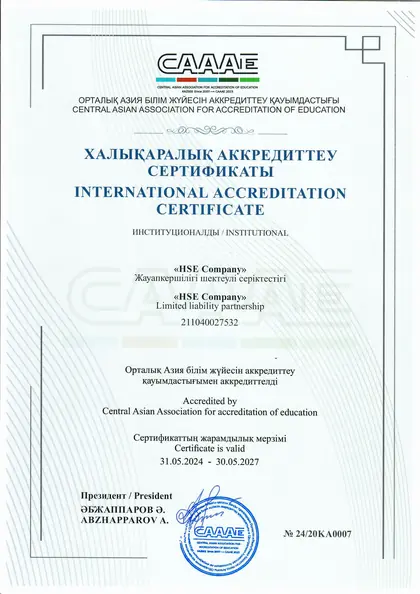
CAAAE international accreditation
Institutional accreditation of the training centre.
Questions
Frequently asked questions
Didn't find the answer? Message us — we'll reply during working hours.
Ask on WhatsAppHow long is the course?
It depends on the programme and group size. We'll tell you when we quote.
Is there hands-on practice?
Yes, it's the core of the course. Every participant practises resuscitation and injury first aid.
What document is issued?
An officially recognised certificate.
Can classes be held at our premises?
Yes, we bring mannequins and materials to your site.
Free consultation
We'll quote the training cost from a single message
Tell us how many employees and their job titles. We'll pick the programme and suggest dates.
Request sent
Thank you! A manager will call you back during business hours. If you prefer, message us on WhatsApp: +7 775 506 99 99.